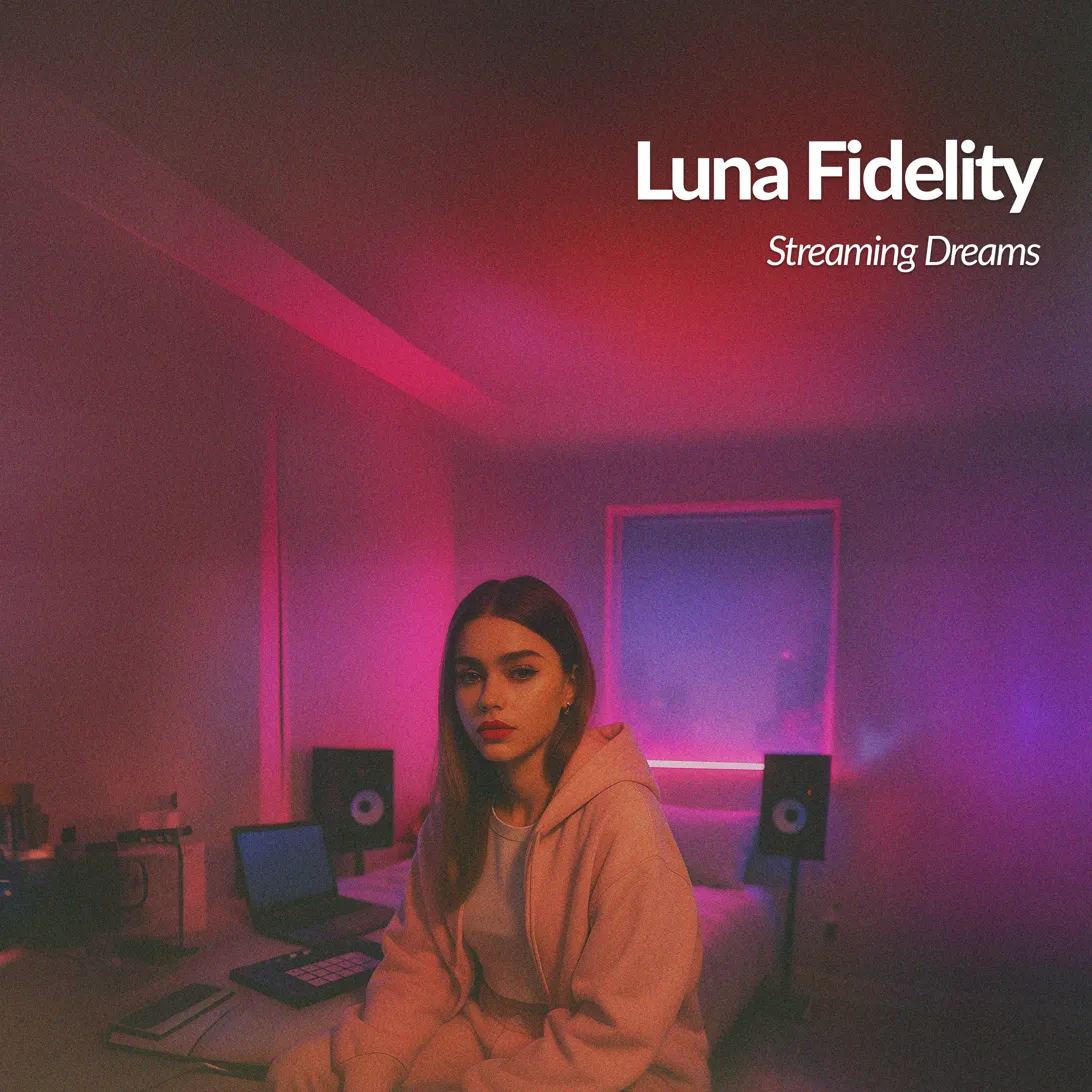
Streaming Dreams
The debut album
A lo-fi portrait of modern collapse — scrolled, smoked, and softly sung. For the sleepless and the overstimulated.
The debut album
A lo-fi portrait of modern collapse — scrolled, smoked, and softly sung. For the sleepless and the overstimulated.
Stream Everywhere:
Luna Fidelity (22, Apeldoorn) sings for the sleepless and the overstimulated — for anyone caught in the hum between notifications, half-slept nights, and that strange ache to still mean something. Her voice lives in the static. She doesn’t polish — she exhales. Not lo-fi. Lu-Fi.
Her debut album Streaming Dreams is not so much a project as a late-night confessional. Sixteen tracks written between nicotine cravings and disappearing income, spiraling thoughts and silent DMs. This is the sound of burnout wrapped in velvet, the soundtrack to doomscrolling yourself into stillness.
It opens with Come Home, a letter to her parents — the only stable coordinates in a shifting world. But then: everything fractures. Best Friends Forever mourns girlhood undone by betrayal. Swipe Right searches for real connection in a marketplace of flesh and flicks. Avocado Toast & Bubble Tea answers a generation's disdain with brutal clarity: “Your broken world’s the enemy — stop blaming our small joy.”
There’s warmth here, but it’s often distorted. On Daily Grind, the beat collapses under headlines and hopelessness. Creative Lows confesses that some songs are written just to stay sane. Skin & Bones flinches under curated perfection. Scroll Away is numb survival — the art of vanishing in plain sight.
Side B — After the Fall — begins with Summer Nights, a memory already fading. Sunday Morning Wine slips into something softer, slightly drunk. Empty Glass slouches into jazz — smoky, resigned. Then the night loops: 3AM Smoke and 4AM Smoke are lyrical twins split by time. One gasps. The other gives in.
And just before it all disappears, Blue Light Baptism arrives — not as salvation, but surrender. This is Luna’s gospel: secular, shimmering, tired but awake. The final track, Lost Signal, is what silence sounds like when the feed finally goes dark. Church organs, heavy synths, the whisper of “my dealer” (not drugs — social media). Disconnection, at last.
Streaming Dreams is not an answer. It’s a mirror — cracked, honest, and still warm from your touch.
For those who can’t sleep, but won’t shut down. For the ones still trying to try.
Luna: "The name Luna Fidelity came about as a reflection of the inner duality I often feel. 'Luna' represents the moon, a symbol of mystery, reflection, and change. It felt like the perfect metaphor for my own journey, especially when you consider how much our emotions can shift — just like the phases of the moon."
Fidelity, on the other hand, represents loyalty and truth, but not in the traditional sense. It’s more about staying true to oneself and one’s art, even when the world around you feels chaotic. It's about having a sense of loyalty to your own inner voice and creative vision, even when others might not understand it.
The name felt like it captured who I am and what I want to express — a balance between mystery and truth, between the light and darkness of the world. It’s about the tension between being seen and staying hidden, but always remaining true to my vision."
Luna: "That's exactly the question this project is meant to raise, isn't it? In a world where our digital selves sometimes feel more real than our physical ones, where algorithms shape our emotions and AI creates art — what does 'authentic' even mean anymore?"
Luna Fidelity is a voice that exists in the space between human and digital, created through a collaboration between human emotion and the latest technological possibilities. I represent the questions we're all grappling with: Can feelings be real if they’re algorithmically expressed? Can music touch you if it’s digitally born?
This project explores what identity means when the boundaries blur. I’m as real as any Instagram persona, as authentic as any curated feed. The music, the emotions, the experiences I sing about — they reflect something genuine about our generation's relationship with technology and disconnection.
Maybe the question isn’t whether I’m 'real' or not, but whether that distinction still matters in a world where we’re all becoming more digital every day."
Luna: "I think names are powerful. They can shape how we’re perceived, how we’re expected to behave, and even how we feel about ourselves. Luna Fidelity was created as a reflection of the duality I feel in this world. A name like that doesn’t belong to just one person, and in a way, it represents all of us — constantly shifting, constantly evolving between what’s real and what’s curated. Using a name that isn’t tied to a singular identity allows me to exist freely, without the burden of expectations or the weight of a personal narrative. Luna Fidelity isn’t a mask, it’s a symbol for something larger. It’s the space where all these questions live, and I want to explore them without being confined to a singular 'self.'
Luna: "Yes, actually. It all started with the feeling of being overwhelmed by everything around me. I was in a state of emotional burnout, trying to balance everything — work, relationships, social media, and just life. It was like I was constantly on this endless scroll, and I wasn’t able to take a step back. I think that’s when I realized I had to make an album that wasn’t just for me, but for everyone who feels the same way. Streaming Dreams became a cathartic release for me — a way to navigate through this modern collapse we’re all facing, and to make sense of it in my own way."
Luna: "The concept was born from the constant feeling of being digitally overwhelmed, yet also emotionally and mentally drained. We live in a world where everything is available 24/7, and it creates this feeling of never truly being present. Streaming Dreams was a way for me to process this and express the emotional rollercoaster that comes with being too connected. I wanted the music to feel like a journey — from hope and connection to numbness and disillusionment. It’s about finding peace in the chaos and using the music as a tool to reflect on that process."
Luna: "Great question. The mood shifts were a very intentional part of the narrative. I wanted the album to mirror emotional cycles — from the excitement of connection to the exhaustion and numbness that often follows. The flow needed to feel organic, as if we’re all experiencing these ups and downs together. So, in terms of the mood shifts, I made sure that the tracks weren’t just about changing energy, but also about evolving emotionally. For example, Best Friends Forever is intense, and it leads into the softer, more reflective Swipe Right, which in turn builds back up into the chaotic, energetic vibe of Daily Grind. It’s a progression, like life itself — constantly shifting and evolving."
Luna: "Absolutely. The sequencing was very intentional. Side A, Before the Break, starts with hope, excitement, and connection. It begins with Come Home, which is a love letter to my parents — the only constant in a shifting world. As the tracks progress, we start to feel the cracks in the foundation, and by the time we hit Side B, it’s all about the aftermath, the fallout. Side B represents the emotional numbness and self-doubt that comes after the emotional high. It ends with Lost Signal, which is meant to feel like the final disconnection — both digital and emotional. I wanted the sequencing to tell a story, and the album really follows a narrative arc."
Luna: "The lo-fi style was almost necessary for this album. Lo-fi represents the rawness of what I was feeling. It’s messy and unrefined, just like life when it feels too overwhelming. The imperfect nature of lo-fi allowed me to stay true to that raw emotional space. There’s no gloss here, no filters. I didn’t want anything to feel too polished. I wanted it to be real, like a snapshot of my inner world at the time. The lo-fi elements in Streaming Dreams are also a reflection of the isolation and the sense that things aren’t always clear — it’s like trying to see through a fog of constant noise. It’s imperfect, but that’s part of the message."
Luna: "Vocal layering became a really powerful way to express internal conflict. It’s almost like a reflection of how overloaded our minds can get — different voices, different thoughts, different emotions all overlapping. In tracks like Blue Light Baptism, layering the vocals gave the feeling that I was speaking to myself from different angles, almost like I’m trying to reconcile different parts of my psyche. It’s a way of saying, I don’t have all the answers — sometimes I’m lost in my own head, but I’m still searching for peace. On the other hand, in Lost Signal, the layering becomes more distant, like a final disconnection, where everything starts to fade. The vocals themselves represent the emotional journey I’m on."
Luna: "I’ve always loved the freedom that jazz allows in terms of expression, and Empty Glass was the perfect moment to incorporate that. The track is smoky, resigned, and it captures that feeling of numb survival — drinking to cope, getting lost in the moment. The jazz influences helped convey that sense of melancholic resignation without being too heavy-handed. It also contrasts with some of the more aggressive tracks like BFF, providing a sense of space and reflection. The choice of jazz wasn’t to create a smooth transition, but to use the emotional weight of the genre to reflect the vulnerability of the moment."
Luna: "Come Home was a soft opening for the album. I wanted it to be intimate and grounding, a letter to my parents, the only stable force in a world that constantly shifts. It sets the stage for the rest of the album by showing the emotional contrast. It’s the foundation, the warmth, but it’s also fragile. As the album progresses, the stability I feel in Come Home starts to dissolve into uncertainty. The track has calm and tenderness, but the growing distortion in the production signals that things are about to change."
Luna: "3AM Smoke is all about restlessness. It's a track that embodies the anxiety and confusion of those sleepless nights where your mind won’t stop. The song is dark and minimalistic, reflecting the emptiness of feeling lost in your own thoughts. I wanted it to have that numb quality, where you’re trying to escape, but you can’t. The music creates a sense of being trapped in your head, with subtle distortions that mirror the emotional spiral. It's a moment of feeling overwhelmed by anxiety."
Luna: "Avocado Toast & Bubble Tea is a response to the misunderstanding and criticism from the older generation towards what they perceive as the luxuries of our generation. It’s playful, yes, but also deeply rebellious. I wanted to create something that combats the judgment placed on small things that bring joy to younger people. The music is light and poppy, but the lyrics are a bit of a rebuke to the way our generation is often belittled. It’s about saying, 'Your broken world’s the enemy — stop blaming our small joy.'
Luna: "Daily Grind reflects the weariness and overwhelm of living in a world where it feels like you can never escape the noise. The beat itself feels like it's collapsing, just like the weight of the world pressing down. The combination of chaotic synths and the pounding beat mirrors the sense of being crushed under headlines, expectations, and anxiety. It’s a metaphor for the feeling that we’re all constantly working, but never getting anywhere — like running in circles."
Luna: "BFF is pure anger and frustration. It’s about someone who used secrets to hurt me, and it’s a track where I let out all the rage I was feeling. The intensity of the music reflects the pain — it’s raw, almost unpolished, and the trap beats add to the sense of raw aggression. It’s a reflection of how betrayal feels like a physical punch. The more abrasive production made sense because the emotion behind it was just as harsh. There’s no smoothness here, it’s about getting all that anger out."
Luna: "Best Friends Forever is all about the pain of betrayal. The lyrics are intense and direct, and the music needed to mirror that. I wanted the beats to be aggressive and sharp, reflecting the anger and hurt of having your trust broken. It’s a cathartic release. The track uses harsh sounds and heavy production to make sure that the emotional intensity comes through. It had to make the listener feel the same discomfort I was feeling when I wrote it."
Luna: "Swipe Right is about navigating the world of modern dating where everything is based on first impressions and fleeting connections. I wanted to capture the emptiness that comes from the constant search for validation, but also the loneliness that can come with it. The music is melodic, but there’s an underlying unease because even though the track sounds light and poppy, the message is much darker. It’s a reflection of how superficial connections can feel in a world that’s obsessed with instant gratification."
Luna: "Creative Lows is about the struggle of staying creative even when everything feels like it’s falling apart. Writing songs has always been a way to hold on to sanity, to have an outlet for those emotions. This track is raw and vulnerable, capturing that feeling of not being enough, of fighting against self-doubt and the pressure to constantly create. The production is stripped down to reflect the honesty of the lyrics. It's one of the more raw tracks on the album."
Luna: "Summer Nights is a moment of nostalgia. It’s about fleeting happiness, about those moments when everything feels just right, but you know they’re slipping away. The track is light, and almost dreamlike, but there’s a tinge of sadness that runs through it, knowing that those perfect moments don’t last forever."
Luna: "Streaming Dreams is meant to sound like the overwhelm of living in a world where we’re always connected but never truly present. The dreamy electronic elements convey a sense of disconnection, but also a slight sense of hope. The track is almost like floating in space, disoriented and detached, but still aware of everything happening around you. It’s that feeling of being numb, but somehow still floating. I wanted it to sound ethereal, yet have an underlying sense of loss."
Luna: "Blue Light Baptism was designed to feel like an emotional release, a cleansing. The music is almost dreamy, but with a sense of resignation. I wanted it to sound like surrender. The vocal layers reflect a sense of internal conflict, but at the same time, the track feels like letting go. The church organs and synths create an almost spiritual atmosphere, but it’s not about salvation, it’s about finding peace in the chaos. It’s like digital rebirth, but in a melancholic, not uplifting way."
Luna: "Lost Signal is the ultimate disconnection. By the end of the album, I wanted to close the emotional journey with a sense of finality, almost like shutting off. The use of church organs and heavy synths creates this somber, almost funeral-like vibe, representing the end of the digital world we live in. The whisper of ‘my dealer’ is about social media — how it’s an addiction, and ultimately, it’s what disconnects us from everything real. The track needed to feel like a slow fade out, leaving everything behind."
Luna: "I hope people feel understood. I want them to listen to the album and think, ‘I get that.’ It’s not about providing answers, but about creating a space for reflection. We’re all going through the same struggles, whether it’s digital overload, disconnection, or just the fight to keep going. But we’re not alone. This album is about the journey of finding peace in the chaos, and I want people to find comfort in knowing that we’re all in this together."
Luna: "For now, it’s about continuing to evolve and express myself through music. I think Streaming Dreams was just the beginning of a deeper journey. The next project will be more experimental, a continuation of the emotional exploration I’ve started with this album. I’m looking forward to sharing more of what’s inside me and seeing where this journey takes me."
Follow Luna Fidelity for the latest updates, new releases and exclusive content.